NEWS

Insights for Change: Success metrics for faith communities in a changing world
In April, we hosted a conversation with Henry De Sio, Stephen Lewis, and Rabbi Elan Babchuck about how people and communities of faith can lead in a world of explosive change. One thread that emerged in the conversation was the question of how faith institutions think about success in a changing world. As Elan explained, “The old way has an old set of KPIs [Key Performance Indicators]: budgets, butts [in seats], and and buildings. This puts us in the entertainment industry, not the transformation industry.” So let’s start imagining a different framework, one that helps us position our leadership to bring transformation to an increasingly complex world. What would that look like?

Changemaker in the mirror: Equipping ourselves for a new game
Even before the pandemic abruptly disrupted the entire planet all at once, our world had become a place of constant change and accompanying uncertainty. It’s a new game, different than the one many of us have been taught to play - the one that plotted a linear, generally secure path from education to job to career. And to power, for those with the ambition and privilege to land in positions of leadership. The game has changed, and how we equip ourselves for it is the question at the heart of a new book by Henry De Sio, Changemaker Playbook: The New Physics of Leadership in a World of Explosive Change. Hint: everyone leads.

Faith and philanthropy: Bridgespan Group report points to an untapped opportunity
A new report by the Bridgespan Group, Elevating the Role of Faith-Inspired Impact in the Social Sector, makes a case for bridging secular philanthropy and faith-inspired social impact organizations. The report addresses three myths: 1) that secularism is dominant, 2) that faith-inspired organizations represent only a minor part of the sector, and 3) that faith-inspired organizations are not innovative.

Was January 6 a last gasp or a first spark? It's up to us to decide
As predictable as the events of January 6 should have been, they have forced us to make a choice. And we should all take a deep breath and a hard look at ourselves, as a society and as individuals, before proceeding. …Our institutions remain strong. But what about us? Depending on how we direct it, that fury we feel can drive us either to real change or to civil war. Stepping out of the emotions of the last week (or years) and into a creativity or innovation mindset can help us choose the former. Specifically, if we activate our empathy, loosen our grip on our ideologies, and leverage our assets, we have a real chance at forging new horizons for our democracy in changing times.

Our great creative project: Pope Francis helps us turn the page to a post-2020 world
In October, Pope Francis published his third encyclical, Fratelli Tutti (Brothers and Sisters All). For those not versed in papal encyclicals, they're significant communications from the Pope on particular aspects of Catholic doctrine, though they may speak to a broader audience than just Catholics. This Pope’s previous encyclical, Laudato si’, is a widely-read, profound, and pioneering statement on the ravages of climate change and our need to act, which has inspired numerous new initiatives and collaborations.
But an encyclical about brotherhood honestly sounded a little mundane to me. I sat back and started skimming, expecting a prophetic but predictable exhortation to love and neighborliness. By the end, I was quite literally at the edge of my seat, reading and re-reading portions. This wasn't prophetic, it was something better: real, relevant and actionable.

What's spirituality got to do with it? A new study offers some insights
In September, the Fetzer Institute published What Does Spirituality Mean to Us? A Study of Spirituality in the United States, a fascinating snapshot of spirituality across the country and its relationship to community and civic action. One of the most interesting takeaways from the study is that while it shows a strong correlation between spirituality and pro-social action, fewer people explicitly make a connection between the two in their own lives.
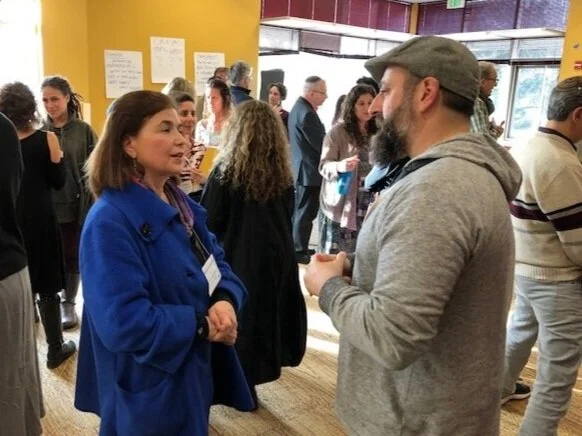
"How do we keep a people as old as Moses innovating?" Insights for institutional religion from a gathering of spiritual innovators
Last month, I had the opportunity to attend a gathering of the Kenissa network, a group founded by Rabbi Sid Schwarz, that brings together leaders who are re-imagining Jewish life and fostering "communities of meaning." Kenissa supports and connects these leaders to help their efforts and emerging communities to thrive. The gathering was representative of a growing movement of faith-based innovators operating outside the bounds of traditional religious institutions and a model of three characteristics I believe our religious institutions must learn to adopt if they are to flourish in the current era and into the future.

The 5 Essential Assets Faith Communities Bring to Social Innovation
Social innovation has developed largely as a secular field despite its deep historic roots in people and communities of faith that have quietly and creatively responded to human and societal needs over centuries. It is essential that the faith sector take a place at the table because of the many assets it brings to the goal of solving our world's most pressing problems. Here are a few:

We're not in the game: Religion and the data revolution
During a recent layover, I was wandering the airport bookstore and spotted Yuval Noah Harari’s bestseller Sapiens. “Everyone’s reading this,” I thought. “Maybe I should, too.” But then I saw his follow-up book, Homo Deus: A Brief History of Tomorrow, which I had never heard of but the title of which sold me immediately. … Harari makes some frustratingly sweeping and aggressive statements about religion that seem unnecessary to make his point. But behind them is a truth that institutions of faith need to confront: We’re becoming irrelevant because we’re not in the game. Our traditions may serve a purpose for a while - as sources of comfort in a chaotic world that we don’t really understand, where people like Harari are talking about the imminence of unfathomable things like superhumans and cyborgs. But if that’s the only purpose we’re serving, then we’ve already lost the long game.

The Spectacular Scale of Akshaya Patra: What a Group of Hindu Monks Can Teach Us About Changing the World
We don't often tell them as innovation stories, but history is full of examples of faith communities and institutions developing new ideas for addressing social problems. All the destructive things done in the name of religion or by religious people and leaders notwithstanding, when one looks to where good is happening in the world, one will often find people of faith. From building social movements to building schools and hospitals, faith communities have been innovating solutions, often quietly, for the good of humanity for millennia. And they are still doing so today, though the scale of these efforts sometimes feels small under the weight of today's complex problems.
Until one learns about Akshaya Patra.